


There’s No Justice in the World Cup when Technology Blows the Whistle
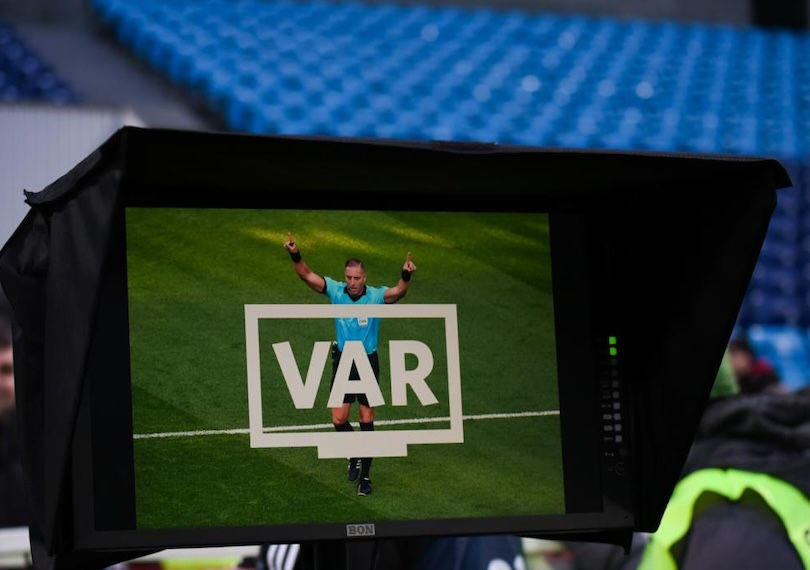
Croatia and Egypt both thought they had scored. But the fifth official, the all-knowing Video Assisted Referee (VAR), disagreed.
The disallowed goals in Portugal v. Croatia and Egypt v. Argentina have spurred the latest men’s World Cup controversies on the rightful place of technology in football law. Croatia’s equalizer was rejected literally by a hair: the game ball sensor detected a signal spike, confirming that Croat Matanovic’s head set the goal-scoring kick offside. The VAR stripped Egypt’s goal upon review of the play’s “attacking possession phase”. The tech caught an uncalled foul on Argentina’s Lisandro Martinez about 100 yards earlier and erased everything that followed.
The VAR debate surrounds the purity of football as a sport: on one hand, the VAR promises perfect execution of the official Laws of the Game, but on the other hand, the technology in practice appears to drain football of its purpose and human spirit.
I argue that the VAR wrongly attempts to override the core subjectivity of officiating with objective results, all while having no framework for legitimacy. Technology driven decisions do not acquire legitimacy because they process more data at higher precision than humans. Any VAR authority, no matter how accurate, must still demonstrate core principles that make any exercise of technological decision-making acceptable: transparency, justification, independence and accountability.
Technology-enhanced football creates endless questions
The VAR team comprises four match officials surrounded by screens in a dark room. They monitor a system of video and sensor data captured by over 20 cameras placed around the stadium, together with data transmitted by the infamous FIFA connected ball.
The system collects “skeletal data” and uses it to create to-scale in graphical reconstructions of the players. These graphics are displayed to match officials and, occasionally, broadcast to viewers. The VAR provides frame-by-frame and slow-motion replays, and when synced with the data from the connected ball, analyzes individual plays at all angles and timesteps. Every goal, the VAR automatically analyses the preceding possession to detect fouls and verify the scorer was onside.
FIFA introduced the VAR in 2018 in recognition of increased speed and aggression in modern football, while referees face more public flack for missed calls. Theoretically, an accurate VAR call can provide fairer outcomes, reducing criticism of referees and allowing them to keep up with the level of competition.
The VAR is extremely controversial because of its inconsistent application and seemingly ad hoc influence on referee calls. In the effort to appeal the red-card suspension of Folarin Balogun, US Soccer claimed that excessive freeze-frame scrutiny using the VAR detracted from the speed and reality of the play, making the foul seem worse than it was. The Egyptian coach criticized the VAR review of the critical foul on Martinez on the same grounds: “After 150 years of viewing such innocent situations as normal contact, we study a three-second loop repeatedly in slow motion and find a ‘foul’.”
The VAR’s commitment to accuracy on the rules must translate to consistency across games. Belgium v. Slovakia in the 2024 Euro Cup semi-final set a precedent for using the connected ball to disallow goals on a strict standard. The ball detected a barely-visible Belgian handball and alerted the referee, with a signature “snicko” graph displayed on screen. Upon a similar situation with Croatia, a passionate viewer might experience the following swirl of thoughts:
Wait, that Croatian touch appears to be a blip compared to the mountain detected against Belgium. But what’s the sensitivity of the ball? And also, what’s the margin of error? How big are those spikes in numbers? FIFA, do you mean to convince me that Croatia was eliminated by this random unsubstantiated wave on my screen?


The Belgian handball snicko (left, cropped from ESPN), compared to the Croatian header (right, reproduced from BBC)
Outcry on the disallowed goals has spread through the media, partly fuelled by conspiracy theories on VAR-match fixing, but mainly from plain confusion on the VAR’s officiating force. Controversial Argentinean goals had scant VAR scrutiny, prompting criticisms of inconsistency and bias within a single match. The scope of VAR technology is opaque: the connected ball justifications took viewers by surprise, causing them to ask, “Is this really what the VAR was made to do?”
Football law is built for human interpretation.
The VAR theoretically has more data, angles and viewpoints on a play compared to the eye of even the most skilled referee. For certain binary rules (e.g. whether the ball passed the goal line), it can catch errors quickly and remove controversy for objective officiating decisions.
The technology of VAR was never meant to allow the referee to conduct a de novo review of a decision. The VAR is a match official, supporting the referee, who acts as a first-instance judge on football law. At the VAR team’s recommendation, the referee can choose to undertake a review of the footage and remain the final decision-maker on whether the existing call (or no call) should stand. The VAR and the standing referee conduct ex post reviews on the standard of “clear and obvious errors” – no reversals are allowed for something that is “probably an error” or “now looks to be an error in slow motion”. To reverse a subjective call short of the “clear and obvious error” standard (e.g. a foul) is re-refereeing induced by the VAR, which is an error in law and review procedure.
On the other hand, the informational asymmetry between the VAR and referee subverts the principle of appellate review that the first instance judge is better informed on the facts of a case. The appellate judge (in this case, the VAR) would be able to reinterpret the facts of an initial play and call. While that is true in law, implying that the VAR feed can take the determinative position in officiating is premised on the idea that all Law of the Games can, and should be, evaluated objectively.
A referee is not a strict judge on the technicalities of rules, and will temper their officiating based on their tolerance of shithousery and game state. When managing a match, they must actively incorporate the tempo and context of the team and game. Sometimes, a referee calms a vocal crowd by making up for missed calls with new ones. A referee may let a penalty slide in the final seconds and let the teams play it out in 30 minutes of extra-time instead. Referees prioritize consistency over precise justice to maintain the flow, pace and competition of an individual game.
It detracts from the purpose of football to view all its rules as objective or better evaluated with precise data. A purposive interpretation of the offside rule, for example, suggests that offside rulings are only necessary if they reach the threshold of evading the skill and timing needed to pass through the penalty area in a high-level game. Disallowing a goal by the millimeter extremity, or an invisible change in ball trajectory has little honour in the official Laws of the Game. The Laws have enshrined values of fairness, integrity, respect, safety, enjoyment; a tedious offside call proves little in ways of fairness, enjoyment and enhancement of the game. This is even more true for the Croatia equalizer that would have surely ridden the competitive momentum into an enjoyable extra time.
Technological accuracy is not fair without independence, transparency and oversight.
Viewers will always complain about referees – it is an accepted part of fandom in any sport that your team might get the short end of the stick on some calls. Given FIFA’s history of corruption, the average viewer is not taking technological accuracy as any solace. In truth, I’ll only believe FIFA if they stream the signal data so I can match up the offside graphic and connected ball signal. While they’re at it, they should label the graph axes so I can see the numbers. Next, I need them to establish a signal threshold for an offside touch judged with the connected ball. And also publicly report their consultation with technical experts. They should allow an appeal to an independent body for a review, and of course let me read the judgement based on the sanctity of open court.
As the VAR gets more technologically advanced, FIFA will have to choose between a robust, ethical approach to interpreting the Laws of the Game, or be subject to endless allegations of corruption. The current use of VAR displaces the judgment and practical wisdom that referees develop through experience. AI will only exacerbate this problem. FIFA is on track to employ AI to further optimize the VAR system, reducing contextual elements into more data points that increasingly shape referees' decisions. FIFA could face criticism based on the AI’s training data, design assumptions, and on how they select “significant” data for broadcast.
Perfect accuracy is a dream. FIFA must draw a hard line on using the VAR for objective versus subjective rules. They must first clarify their standard of review and discretionary capability for referees to overturn crucial calls.
Football fans are calling for basic legal principles: legal certainty, transparency, due process, independence without political influence, and robust practice that sets just precedent for future games. This level of seriousness is necessary when technology starts enforcing rules designed for human interpretation. At least in the sports context, the subjectivity of officiating spurs debate that makes people rally behind teams, anticipate the next game, and engage with the sport. While these VAR cases do the same to some extent, they go too far in impacting fans’ enjoyment of the game and invite questioning of the integrity of the tournament itself.
The opinion is the author's, and does not necessarily reflect CIPPIC's policy position.


